

Finance
Payment Collection Tracking: Instalment Plans, Cash, Bank and Account Statements
An approved quote becomes a debit, the debit becomes instalments, instalments become collections; all tracked from the same record.
From quote approval to collection: instalment plans, late-payment interest, cash and bank accounts, account statements, foreign-currency payments and exchange difference tracking.
Features
What can you do with Payment Collection Tracking?
From quote to debit
Approval writes the account debit and the collection plan in one go.
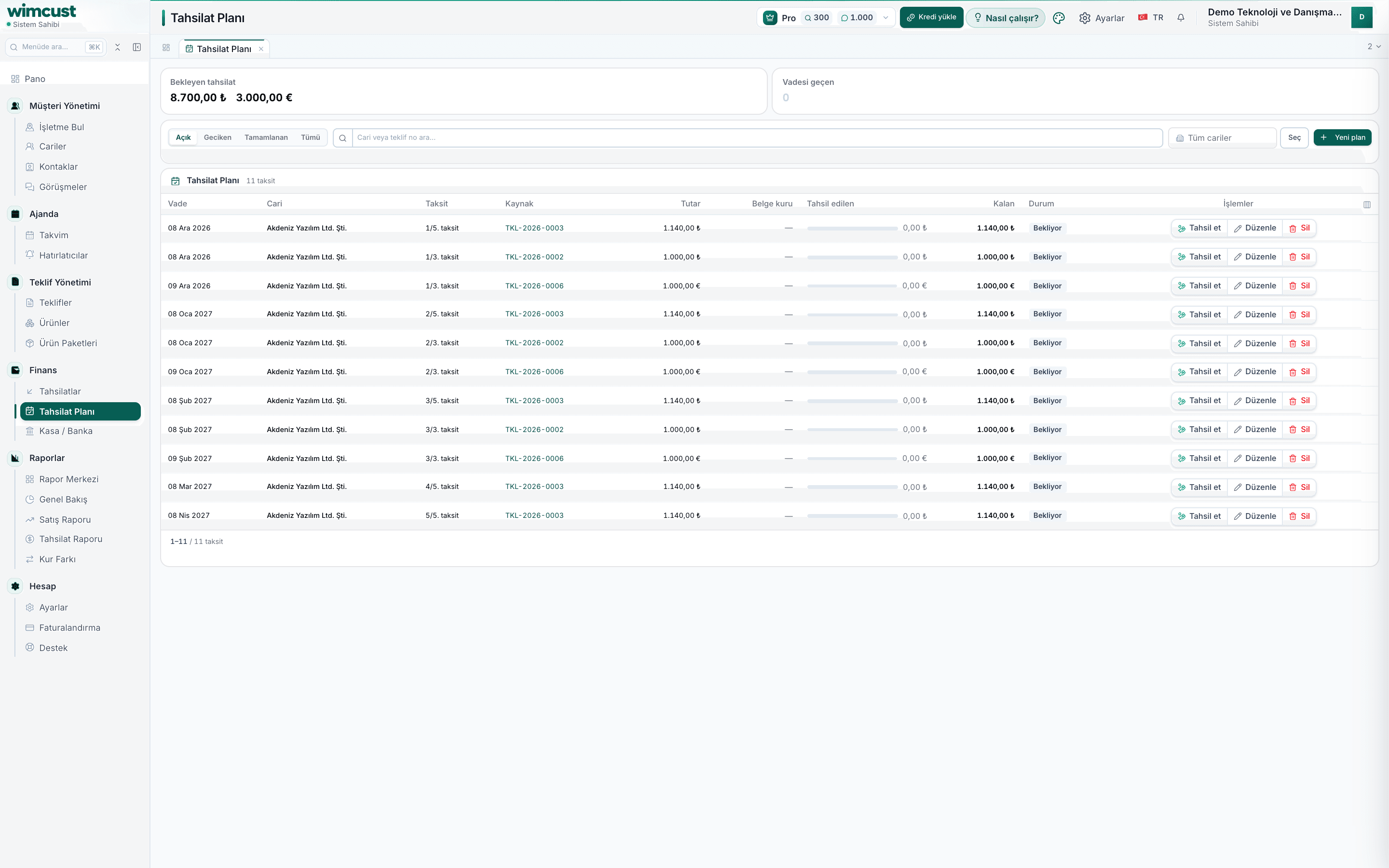
Instalment tracking
Paid amount and status are calculated from collections, not typed in.
Cash and bank
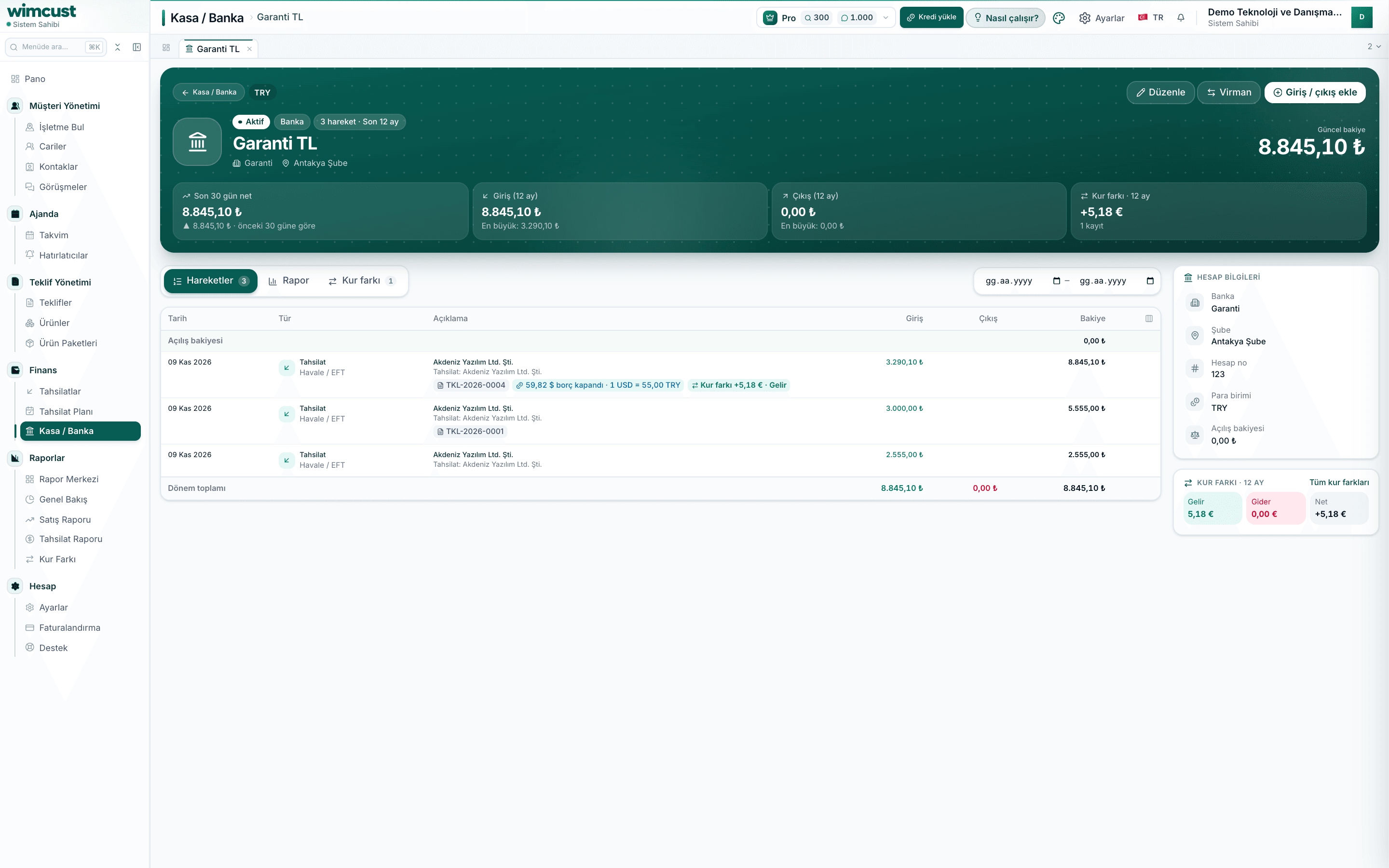
Balance is summed from movements; transfers and manual movements.
Statement per currency
Local-currency and foreign-currency balances are kept separate and not added up.
Foreign-currency collection
The amount entering the account and the amount deducted from the debt are separate, with the rate recorded.
Exchange difference report
The difference between document rate and collection rate, in the main currency.
How it works
Step by step
- 1
Define your accounts
Open cash and bank accounts with their currencies.
- 2
Approve the quote
The debit and collection plan are created automatically.
- 3
Enter the collection
Choose the account; the instalment closes and the statement updates.
- 4
Follow the reports
Ageing, monthly collections and exchange difference.
A sale does not end when the quote is approved; it ends when the money reaches the till. WimCust's payment collection tracking module follows every step, from the approved quote to the last collected instalment, in the same chain of records. There is no need for a separate bookkeeping sheet or due-date lists kept in a spreadsheet.
The flow
- The quote is approved - the customer approves from the online quote link, or you approve from the panel.
- The account is debited - the quote amount is posted to the account statement as a debit.
- The collection plan opens - the instalments in the quote are transferred to finance as expected collections; a single payment if there is no plan.
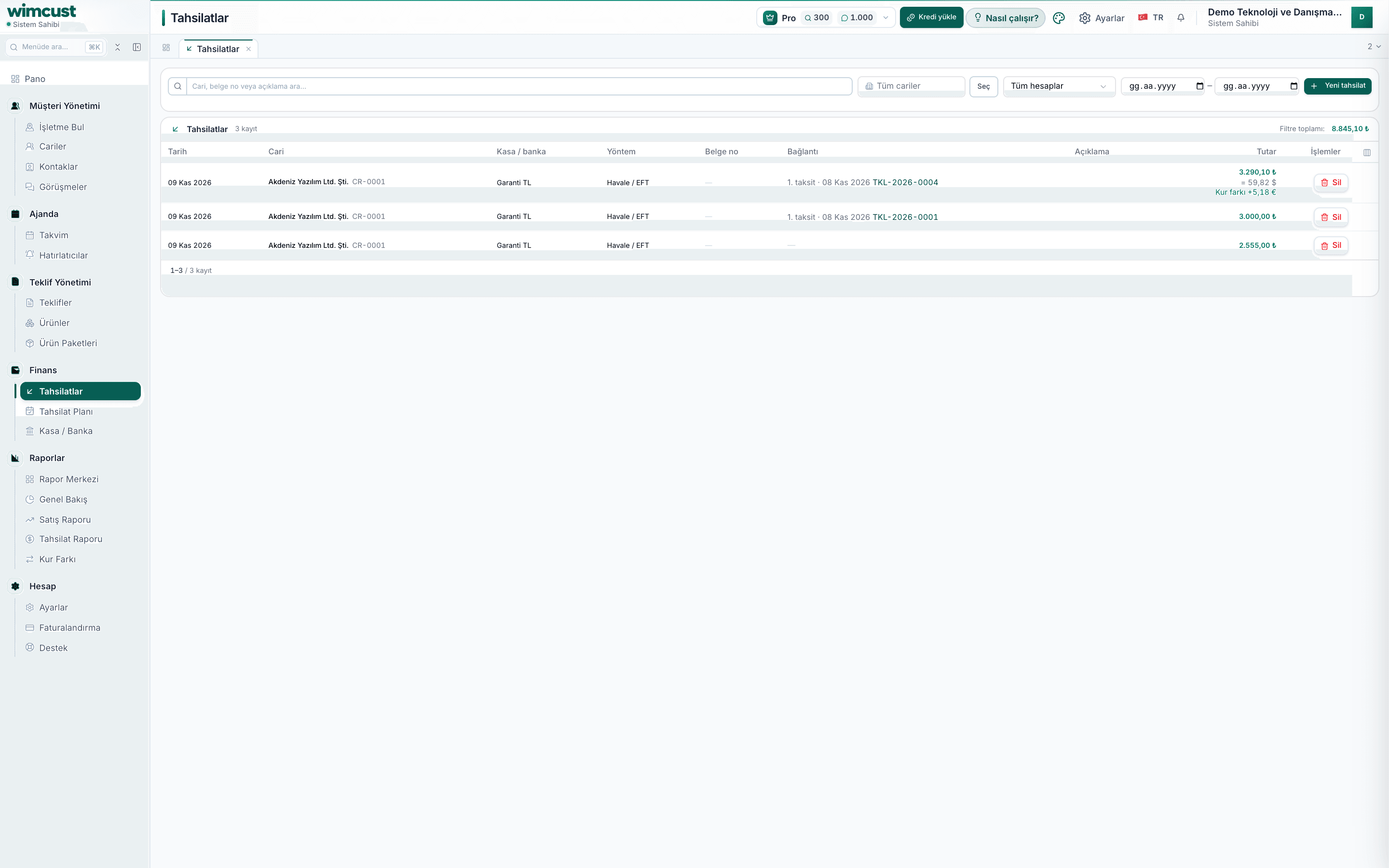
- The collection is entered - it is posted to whichever cash register or bank account the money entered; at the same time it is deducted from the account's statement and the relevant instalment is closed.
An approval writes the debit once; a second debit is never created for the same quote.
Collection plan
Each instalment carries a due date and an amount. The paid portion and status of an instalment (pending, partial, completed or cancelled) are calculated from the collections entered, not typed in. If you delete a collection, the instalment is recalculated and its status goes back if needed.
The late-payment interest is found, when the quote is prepared, from the schedule defined per payment method and the number of deferred instalments; the VAT on the interest is calculated at the weighted rate of the document.
Cash and bank accounts
You define as many accounts as you like, such as a cash register, bank accounts or a POS account. Each account has a currency. The balance is not stored separately but summed from movements, so the balance and the movement list never contradict each other.
- Transfer - a transfer between two accounts in the same currency.
- Manual movement - inflows and outflows other than collections.
- An account that has movements is not deleted but set to inactive; its currency cannot be changed either.
The account detail page shows the source of every movement: which quote it came from, which foreign-currency debt it closed and the exchange difference.
Account statement
Each account's debit and credit movements are listed in a statement. The balance is per currency: if the same account has both a local-currency debt and a dollar debt, the two are shown separately and are not added together.
When a quote's approval is undone, the debit is not deleted; it is closed with a reversing entry and the plans are cancelled. Losing the trail is always worse in accounting. If a collection has been entered against the plan, the approval cannot be undone.
Foreign-currency debt, local-currency payment
A common situation: the debt is in dollars and the payment is in local currency. WimCust records this transaction with two amounts: the local-currency amount entering the account and the dollar amount deducted from the debt. The rate is suggested from the Exchange Rates table and can be changed; when you type one amount, the other is calculated from the rate. The system does not guess the rate on its own.
Exchange difference
If the rate on the collection day differs from the document rate at quote approval, the difference is calculated in the main currency and written to the transaction: income or expense for your company. The exchange difference is not written to the account statement; it is tracked separately. The Exchange Difference report lists these transactions and gives the total for the last 12 months; you can use this report when issuing an exchange-difference invoice. In the collection window you can choose "today's rate" or "document rate"; for a transaction closed at the document rate, the difference is zero.
Due-date reminders
For instalments that are coming due or overdue, automation can send your team a daily list; a payment reminder can also go to the customer. When a collection is entered, a payment receipt can also go to the customer.
Reports
The collection report ages the remaining open instalments (not yet due, 1-30, 31-60, 61-90, 90+ days), and shows the amount collected each month and the accounts that owe the most. Amounts are kept separate by currency.
Permissions
Finance is a company matter. Finance screens and finance reports are tied to separate permissions; if this permission is not given to the rep role, finance information is not visible. In the mobile app, an authorized user can follow cash balances, overdue and upcoming instalments and recent collections.
Frequently asked about Payment Collection Tracking
Is WimCust accounting software?
No. WimCust is a sales-focused CRM; collection tracking is for following receivables that arise from quotes. You keep using your accounting software for invoicing and official ledger work.
Can I collect a dollar debt in local currency?
Yes. The local-currency amount entering the account and the dollar amount deducted from the debt are recorded separately; the rate is suggested and can be changed.
How is the exchange difference calculated?
The collected foreign-currency amount is multiplied by the difference between the rate on the collection day and the document rate, and recorded in the main currency. For a transaction closed at the document rate, the difference is zero.
Can I delete a collection I entered wrongly?
Yes. When a collection is deleted, its cash and statement lines go too and the instalment is recalculated.
Do reps see finance information?
Finance is a separate permission. If it is not given in the role, the rep does not see cash accounts, collections or finance reports.
Features used together
Multi-Language and Multi-Currency: 13 Languages, Automatic Rates, Per-Line Currency
WimCust works in 13 languages; your main currency follows your country, rates come automatically from the TCMB or ECB, and quote lines can be in foreign currency.
See detailsWimCust Mobile: Your CRM in the Field, in Your Pocket
With the WimCust mobile app, see your customers on the map, log contacts, manage your calendar, send quotes and find businesses in the field.
See detailsTeam and Permission Management: Roles, Permissions and Rep Portfolios
Set your team's permissions for web and mobile separately with ready-made system roles or your own roles; reps see only their own portfolio.
See detailsSign up and find your first 60 prospects for free
Try Payment Collection Tracking today
The Starter plan is free forever. Open your account without a credit card and create your first customer card in minutes.